
The new (para)normal
Reflections on ‘Chasing the Dark’ by Ben Machell

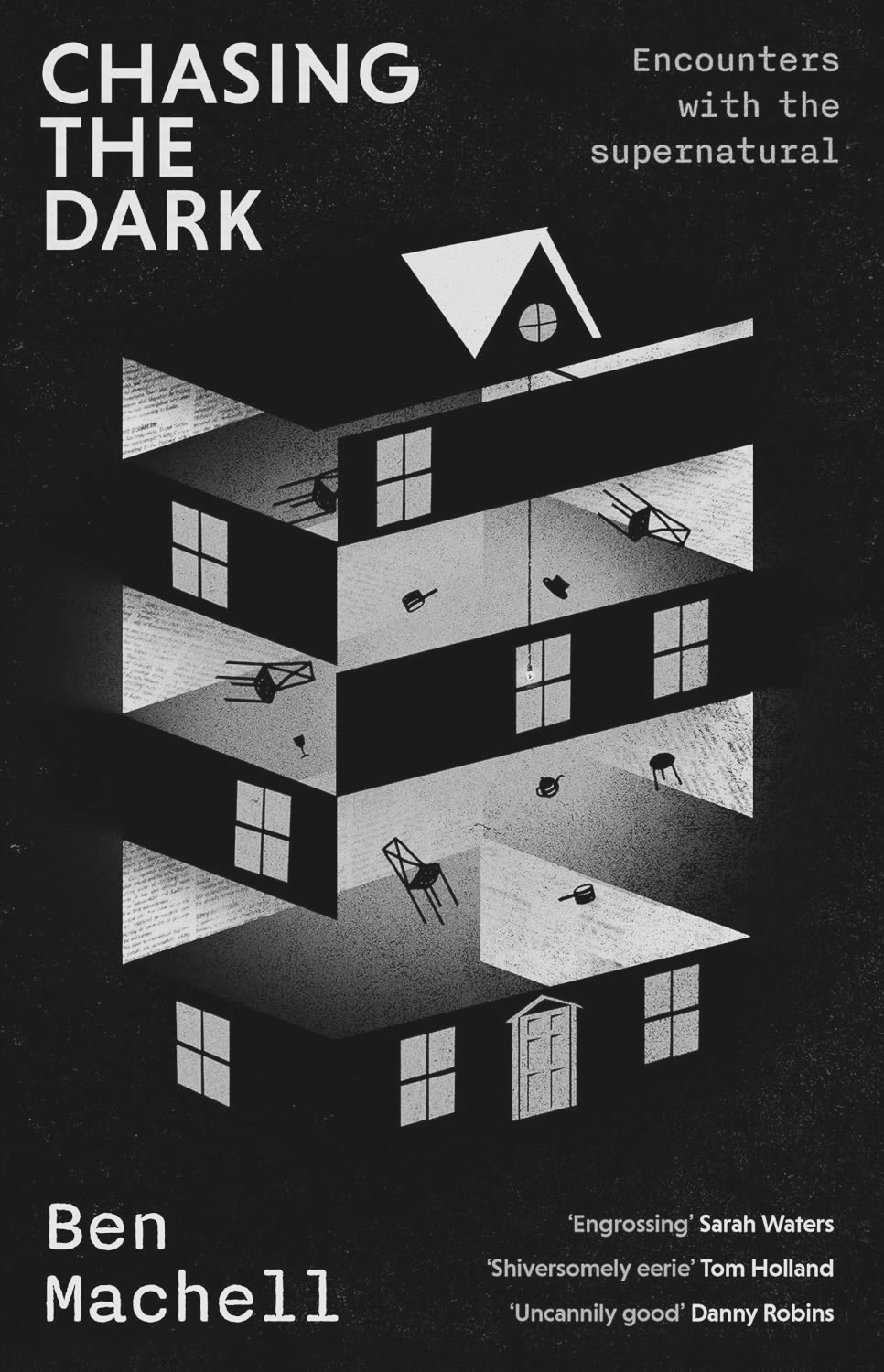
Chasing the Dark is a biography of the prolific parapsychologist Tony Cornell (1924–2010), who was a leading figure in the Society for Psychical Research (SPR) for half a century, and perhaps its most prolific investigator of ‘spontaneous cases’ – that is to say, reported paranormal phenomena happening out there in the everyday world rather than under laboratory conditions. Ben Machell’s interest in Cornell arises not so much from the volume of his work – although the richness of the archive related to Cornell is surely one reason the author chose him as a subject – as from Cornell’s unusual attitude towards the paranormal. Unlike most other paranormal investigators of his time (and indeed of the present), Cornell identified neither as a believer nor as a sceptic, and maintained his agnosticism regarding the paranormal to the very end. Machell observes that Cornell displayed ‘a consistent willingness to be wrong’ that contrasted with the evangelical scepticism or credulity of many of his SPR colleagues.
Chasing the Dark is, in part, a meditation on what it means to choose such a difficult and challenging intellectual path as agnosticism on the paranormal. After all, it is a great deal easier to come down on one side or the other when it comes to questions where there is no consensus (of which the existence and nature of paranormal phenomena is surely one of the most prominent) – and where the absence of consensus is partly down to disagreement over the very validity of the field of study that seeks to answer them. The study of the paranormal tends to select automatically for people who have very strong views on the reality or unreality of such claimed phenomena - otherwise, why wouldn’t they simply choose to study something else? But Cornell was clearly an obsessive individual who would stop at nothing to pursue alleged paranormal phenomena in the wild – to the point of blowing up numerous relationships and alienating people. He was driven, it seems, by a single formative experience of encountering the impossible when he was an officer in the Royal Indian Navy during the Second World War (so as not to spoil the book for anyone, I won’t reveal what that experience was). Cornell’s impossible experience put me in mind of another former colonial official who was changed forever by his experiences in the Empire and returned to England with a single-minded, obsessive and eccentric interest – namely Gerald Gardner.
Machell’s book wonderfully evokes the drabness of post-War Cambridge and the Fens that Cornell came home to in 1945. He was a direct contemporary of my great uncle, who was a student at Cambridge at the same time (but never served in the War, and certainly had no truck with the supernatural – although he shared Cornell’s characteristics of ingenuity and tenacity). Cornell began his association with the SPR at something of a low point for parapsychology in England; the Second World War was not followed by the same outpouring of interest in Spiritualism as the preceding conflict had been in the 1920s. People collectively turned to more material concerns, and mediums and séances were declining in popularity in the 1950s. However, Cornell moved with the times as the SPR rode the wave of renewed popular interest in the paranormal in the 1970s – although Machell notes the unease that Cornell and some other SPR members felt about parapsychologists’ encouragement of the ’70s mania for woo. This culminated in Cornell’s clash with Maurice Grosse and Guy Lyon Playfair, both believers, who had been sent to investigate the notorious Enfield poltergeist.
In the Enfield case, as elsewhere, Cornell trod a middle course between supernaturalism and the stereotyped sceptic’s ‘gotcha!’ in exposing deliberate fraud. He was wary of supernatural explanations but was open to a complex view of human psychology in which people who simulated paranormal phenomena were not always aware they were doing so, or did not necessarily see a distinction between their own agency and that of the supernatural power they believed in. He spent decades attending séances and studying mediums, long after most of his colleagues had dismissed them as laughably outdated parlour tricks – not because he believed mediumship was real but because he was fascinated by the curious psychological borderland that the non-fraudulent mediums occupied. These were individuals so deeply invested in their own identity as mediums that they entered genuinely dissociative and trance states and acted with complete sincerity; far from being fools who came to believe their own frauds, they were unwittingly exploring - and pehaps transgressing - the outer limits of the contained and conscious self. In this respect, if we are able to look past all the fraud and theatrics, it is perhaps possible to discern the outlines of the seemingly perennial practice of shamanism beneath all the paraphernalia of mid-20th century Spiritualism. What emerged in such mediums was perhaps a manifestation of long-forgotten prehistoric (and perhaps ‘pre-religious’) modes of interaction between the known and unknown that transgressed the normal boundaries of the siloed modern self and touched on older constructions of reality, where human consciousness exists in a continuum with other beings.
Cornell had a compulsive ‘need to probe and explore the places where reality does not seem to function as it should’ – a kind of addiction to the impossible which, as Machell points out, verges on the masochistic in sincere paranormal researchers. After all, the sincere researcher knows that in the vast majority of cases they will either find fraud, a plausible explanation well within known parameters, or a psychological or personal crisis of some kind. And yet the possibility of that quarry of the indubitably impossible, which Machell had experienced all those years ago in India, seems to have motivated him to sift through the chaff in the hope of finding gold. He never definitively did so, and as the wave of cultural passion for the paranormal characteristic of the 1970s faded, Cornell encountered another dearth of strangeness. By the mid-1990s he had begun to believe that people were too distracted by modern technology to be in a state where they were apt to experience paranormal phenomena; people were no longer reporting phenomena to the SPR, and in 2004 The Guardian even published an article on the subject of the decline of the paranormal, ‘What’s Happened to Weird?’
In retrospect, as Machell notes, this all seems rather silly. Just because people were no longer reporting phenomena to the SPR, that did not mean they had stopped experiencing them. Instead, just as people had stopped going to church but retained religious beliefs, so they had stopped reporting paranormal experiences to the ageing personnel of the SPR but continued to experience the paranormal, and this became clear with the emergence of social media in the late 2000s. Nevertheless, Cornell was perhaps right that people were living lives too technological and hectic to notice paranormal phenomena – an observation borne out by the upsurge in paranormal reports during the Covid-19 lockdowns when people were forced to spend a lot of time at home and interact continuously with the same spaces. We are now living through a post-Covid renaissance in interest in the paranormal, of which Chasing the Dark is itself a product. But it feels rather different from the 1970s, the last great golden age of woo. The ’70s was a time of theories and pseudoscience, but such speculation is out of vogue in the 2020s; to be sure, people want to experience the impossible, but they are a lot less interested in explaining it. The popular podcast Uncanny toys with explanations but never actually reaches any conclusions, maintaining a neutral editorial line more effectively, perhaps, than any other programme broadcast by the BBC. And that neutrality – or rather suspension of judgement – is part of what makes it so compelling, given that most people are unwilling to commit themselves either to uncritical belief or hard scepticism.
Tony Cornell’s appeal in the modern world lies, Machell argues, in his embodiment of a kind of person rare today, who is slow to take sides or adopt strident opinions. Cornell was arguably a sceptic of the true kind – that is to say, not a doctrinaire unbeliever passing himself off as a ‘sceptic’, but someone genuinely suspending judgement and trying to form a view based on the evidence alone. And while Cornell seems a rather old-fashioned figure in his interest in séances and methodical devotion to spontaneous cases, in his rejection of reductive explanations he comes across as strikingly modern – more relevant than either the endlessly theorising believers or the cynical unbelievers of parapsychology’s past, both of whom seem rather dated now.
Chasing the Dark ends with a survey of the current state of parapsychology, which is rife with ghost-hunters who stand in the same relationship to parapsychologists as treasure-hunters stand to archaeologists: in other words, the ghost-hunter is someone intent on finding the paranormal whether it is there or not. Many of those ghost-hunters are also content-creators on YouTube and other platforms who are engaged in a parapsychological arms race in search of more viewers and clicks, which results in the ramping up of paranormal claims to echo the latest horror films and cultural preoccupations – but often at the expense of real people, who are genuinely having unexplained experiences and deserve better. Sadly, there are not many Tony Cornells in the modern world who are prepared to sift all the evidence carefully and unglamorously and find the human story behind the paranormal.
My wife reviewed this for the FT (Fortean Times, not any other publication in our household) and similarly recommended this, with a more restricted word count.
This has prompted me to finally buy this book