
A bookplate speaks
Who was Cecil Harkaway Edley-Morton?

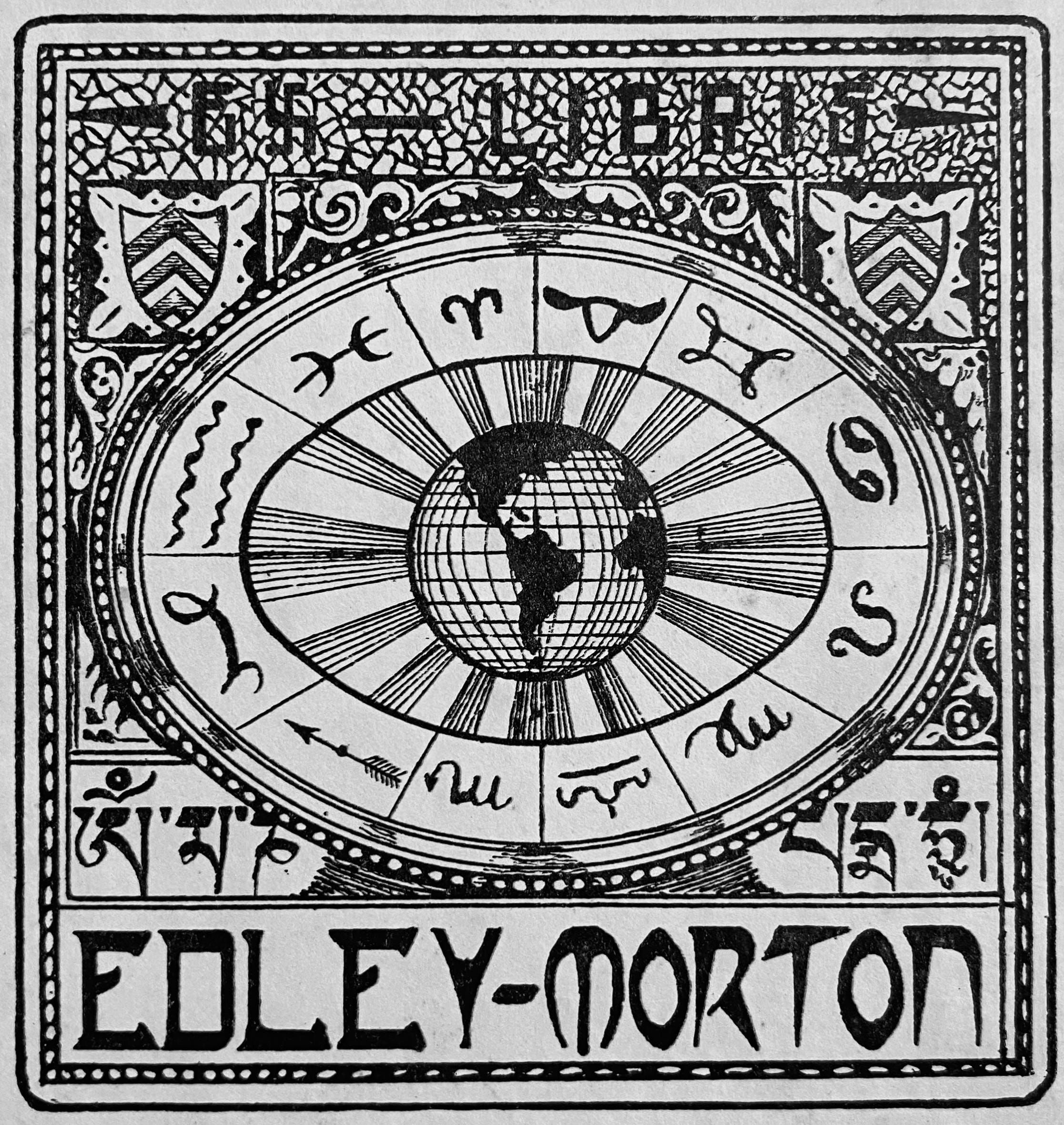
Earlier this month I managed to get hold of a copy of a rather scarce book, Bernard Sleigh’s The Gates of Horn (1926) – a volume little known today, but which has quite a reputation among scholars interested in the history of fairy lore because its portrayal of a fictional ‘Society for the Investigation of Fairy Fact and Fallacy’ inspired the formation of a real-world Fairy Investigation Society a year after its publication (a remarkable story that has been told by Simon Young). What intrigued me on first opening this particular copy of The Gates of Horn was a bookplate from a former owner. In all honesty, I would be interested in anyone who owned a copy of Bernard Sleigh’s book, since it is not only scarce but also catered to a somewhat specialist interest group in its unashamed avowal of the reality of fairies. So few were the people who really took fairies seriously in the first half of the 20th century that I am eager to know who they all were. But this bookplate seemed especially interesting and suggestive in its design.
At the centre of the bookplate is a globe of the world, radiating light, around which are arranged the signs of the zodiac. Beneath the central cartouche are strange, oriental-seeming letters (I thought initially these might be Sanskrit, but they seem to be Tibetan; if anyone can offer further clarity on them, I’d be grateful), and above it are coats of arms bearing simple chevrons. At the top of the bookplate, the ‘X’ of EX LIBRIS takes the form of a swastika – a symbol widely popular before its perversion by the Nazis – while the name ‘Edley-Morton’ appears in a striking and rather out-of-place script at the bottom of the plate, since the letters are redolent of the psychedelic designs of the 1960s rather than the 1920s. Yet, if ‘Edley-Morton’ was the book’s first owner (as seemed likely), then he presumably acquired it shortly after its publication in the 1920s.
So who was ‘Edley-Morton’? Fortunately, the name is a fairly unusual one, and Googling it immediately produced evidence of another book ‘Edley-Morton’ had owned, whose seller on Ebay was also struck by the unusual bookplate. The book in question was a recently sold copy of The Shining Pyramid (1922) by Arthur Machen – who was another of the few people in Britain at the time who took fairies very seriously (indeed, the title story of The Shining Pyramid is about fairies). Anyone whose library contained both The Gates of Horn and The Shining Pyramid was clearly more than just a casual book collector (and had more than a passing interest in fairies). Combined with the unusual design of the bookplate, it seemed likely that ‘Edley-Morton’ was some sort of occultist – perhaps, more specifically, a Theosophist. While use of the swastika was not unique to pre-War Theosophists, they were particular enthusiasts for this Hindu symbol, and the Tibetan (or Sanskrit) letters also pointed to Madame Blavatsky’s influence. A connection with Theosophy was not altogether surprising – Edward Gardner, whose extensive promotion of the Cottingley fairy photographs ignited the 1920s craze for fairies, was a leading Theosophist. Even though the Spiritualist Sir Arthur Conan Doyle is now associated with Cottingley in the public imagination, it was actually the Theosophists who were most enthusiastic about the photographs, which Bernard Sleigh cited as an inspiration for his book in the preface to The Gates of Horn.
I have not been able to establish whether ‘Edley-Morton’ really was a Theosophist, but with the kind assistance of Stephen Buckley (whose research on Edley-Morton has been invaluable) I have been able to establish who he was. Cecil Harkaway Edley Morton (he added the hyphen later) was born in Hitchin on 25 January 1883, the eldest of six siblings, and by 1891 the Morton family were living in Penarth, Glamorgan, as they were ten years later in 1901. We next hear of Cecil in 1911 when, at the age of 28, he was teaching Geography at Witney Grammar School. Then, in 1915, he began teaching at the school with which he would be associated for the rest of his life, Stamford School.
As it happens, I do not live far from Stamford and I go past Stamford School almost every week; indeed, over the years I have twice applied for jobs there and been interviewed, so I know it quite well. Combing through past editions of Stamford School magazines, Stephen Buckley was able to dig up a little more about this Geography master, who married Mabel Annie Flower (1889–1973) at Stratford in January 1918. Cecil and Mabel moved into a bungalow on St Paul’s Street, Stamford known as ‘Scarrington’. In 1920 Cecil began a degree in Geography at University College London at a time when it was very common for older men to be studying for degrees, owing to the postponement of their undergraduate studies by the First World War. I have found no record of Cecil’s own war service, but by 1923 he was back teaching Geography at Stamford School, where he remained until his retirement in 1945 (and thereafter, as a former master living close to the school and involved in its life). His 1960 obituary described him as one of the ‘great academic personalities of the pre-war period’ at the school. According to the obituary,
Mr. Morton had studied with distinction at three universities – Oxford, Cambridge and London. He possessed profound scholarship, and not only in Geography and English. His fund of knowledge, his power of quotation, his linguistic range, his cartographic skill were all amazing. Sixth Formers of those days will remember him for his stimulating lectures. In the lower forms his teaching was equally inspiring and despite his own high standards he never talked down to his classes. By imparting love for his subjects he succeeded in bringing out the best in everyone. His energy was felt, too, in his capacity as Housemaster of the old Town House, as producer of School plays, as doyen of the Stamfordian, and as acting Headmaster in difficult days. Staff knew him as a delightful colleague, full of good humour and happy anecdote. It was an education to listen to him during the writing of reports, and here too his wonderful distinctive handwriting must ever remain a model of clarity. After his retirement Mr. Morton founded the Edley-Morton Geography prize in 1947. During recent years, though confined to devoting himself to his love of books in his large library and to his birds in his garden sanctuary, Mr. Morton maintained his keen interest in all School activities and projects. His passing has caused much sorrow and the School has lost a great friend and character, one who held old-world values with a refreshing modern touch and had a deep reverence for the Christian religion.
‘C. E. M.’ seems to have been a well-liked character at the school, and as far as I know the Edley-Morton Prize for Geography that he endowed may still be being awarded to this day. Cecil Edley-Morton died in hospital at Sleaford on 16 October 1960, at the age of 77.
Although Edley-Morton’s obituary makes no explicit reference to his occult interests, there are some hints. We hear of his ‘profound scholarship’, and not only in his ‘official’ subjects, of his large library, of his ‘garden sanctuary’ (Theosophists with an interest in fairies were often fond of gardening) and of his ‘deep reverence for the Christian religion’ – an interesting choice of words, given that it left unsaid whether Edley-Morton actually considered himself a Christian. Whether these hints are evidence that pupils and teachers knew about Edley-Morton’s more unconventional interests, and simply declined to discuss them, remains unclear; it may be that he kept them entirely private. What we can be fairly certain of is that Edley-Morton never actually joined the Fairy Investigation Society (whose surviving membership lists Simon Young has helpfully published). But only a fraction of those with a serious interest in fairies did – and many probably never even got to hear about the Society, whose membership was always tiny (even if it did include Walt Disney).
It seems unlikely we will ever learn much more about Cecil Harkaway Edley-Morton, but he stands as an intriguing example of the potential readership for books about fairies in the 1920s – intellectually curious, a latecomer to higher education, a career schoolmaster. When and how he became interested in Theosophy (if that was indeed his spiritual affiliation) remains unclear, but the design of his bookplate – anticipating as it does the psychedelic scripts of the 1960s – is a reminder that the counterculture of the 1960s ‘C. E. M.’ never lived to see was surprisingly derivative, and heavily indebted to the psychonauts of the 1920s (and indeed the Decadents and Aesthetes of the 1890s and 1900s) – people like Edley-Morton, who lived quiet and unassuming lives but were not afraid to explore the outer limits of the spiritual realm.
I think it’s ‘Om Mane Padme Hum’ written in Tibetan (right to left)
Have you seen this article about Sylvia Townsend Warner's essay 'Kingdom of Elfin' from 1927? It's the first piece she wrote about fairies, which she called Elfins, and then she waited 50 years to start writing her Elfin stories for The New Yorker, published as Kingdoms of Elfin in 1977. This essay was not among the latter, but I republished it in our second collection of Warner's fantasy fiction, Of Cats and Elfins (2019).
https://journals.uclpress.co.uk/stw/article/id/369/